How To Get Social Security Disability & SSI Benefits: Obesity
 Winning A Case with Obesity
With obesity, Social Security will determine whether you satisfy the Non-Medical Criteria, and Disability Criteria. If you do, you are disabled. To satisfy the disability criteria, it is essential you understand your obesity condition, you have disabling Functional Limitations, and you Submit Winning Evidence.
Know To Win
What Social Security Thinks About Your Obesity
Social Security considers obesity to be a medical impairment that worsens other medical conditions. Obesity places additional stress on the body causing the body to work harder and function less efficiently. In Social Security disability cases, it is recognized that obesity most commonly worsens musculoskeletal (joints of the body), respiratory (breathing), and cardiovascular (heart and veins) medical conditions. It is extremely rare for Social Security to find an adult or child disabled based on obesity alone. For those with obesity, a disability finding is nearly always based on a combination of obesity and another medical condition.
Obesity is the excessive accumulation of body fat. Body fat is measured with a body mass index (BMI). There has been much very fair criticism of BMI standards, but nevertheless, they remain the standard way of determining one's amount of body fat.
An adult (over age 19) BMI calculator can be found here - Adult BMI Calculator. Or if you prefer longhand, the BMI formula is as follows: Weight (lb) / [height (in)]2 x 703. Let's go through the formula with an example of an adult who weighs 175 pounds and is 5'9" tall - his BMI is 25.87.
- Formula: Weight (lb) / [height (in)]2 x 703
- Calculation: [175 / (69)2] x 703 = BMI
- Calculation: [175 / 4761] x 703 = BMI
- Calculation: [0.0368] x 703 = 25.87
The adult BMI categories are as follows:
- BMI less than 18.5 - underweight,
- BMI of 18.5 to 24 - healthy weight,
- BMI of 25 to 29 - overweight,
- BMI over 30 - obese,
- BMI of 30 to 34 - obese class 1,
- BMI of 35 to 39 - obese class 2,
- BMI over 40 - obese class 3,
- BMI of 50 to 59 - obese class 3 super obesity, and
- BMI over 60 - obese class 3 super super obesity.
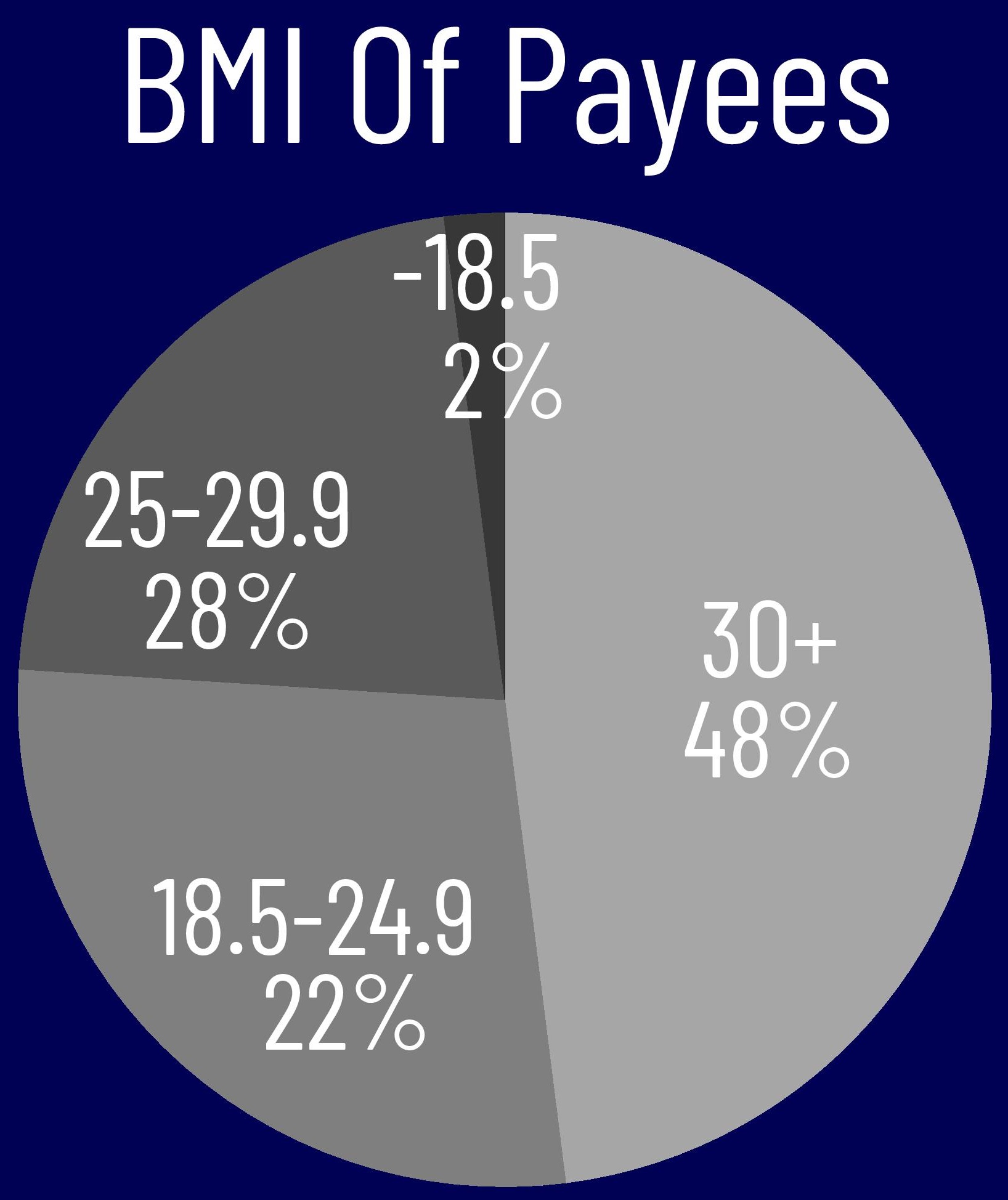
BMI for children (under age 20) is more complicated. First, a child's BMI is calculated using the same formula for adult BMI. Second, a child's age and sex is considered. Third, the child's BMI is measured in percentile rankings. A child BMI calculator that determines all three aspects of determining a child's BMI can be found here - Child BMI Calculator.
The child BMI categories are as follows:
- BMI less than 5th percentile - underweight,
- BMI of 5th to 85th percentile - healthy weight,
- BMI of 85th to 94th percentile - overweight, and
- BMI over 95th to 100th percentile - obese.
Step 3 - The Listing
There is no specific listing for obesity (it used to be Listing 9.09, but Social Security rescinded it in 1999). Hence, you cannot meet a listing with obesity by itself.
You can meet or equal a listing with obesity if the combined effects of your obesity and another impairment cause your symptoms to meet or equal the criteria of the listing.
Obesity is directly relevant to three listings: 1.00 Musculoskeletal System, 3.00 Respiratory Disorders, and 4.00 Cardiovascular System.



 Do you suffer another medical condition? If so, visit our Site Menu-Home page to find that review. You may have another way to prove disability.


 Default Email
 Hotmail/Outlook
 Gmail
Gmail Yahoo Mail


 By Us.